


Adapted from Sharp as Hell
Developed through years of research and personal testing, the Cohesion principle was adapted from Chapter 4 of Dave Bowden’s Amazon-bestselling book, Sharp as Hell: A No-BS Style Book For Men.

Key Takeaways
If you only remember three things from this guide, make ’em these:
1. Cohesion is the Key: Even if each individual piece looks good on its own, your outfit won’t come together unless all the pieces work toward the same look and feel.
2. Vibe is the Foundation of Cohesion: Before you get dressed, figure out the overall tone, or “why,” behind your outfit, then make sure every item you choose supports that mood.
3. Each Element Should Be in Sync: When your colors, fabrics and fit pull in different directions, the whole look feels disjointed.
After years of living in downtown Toronto, a city of about 4.5 million people, my wife and I decided to move back to the small(ish) town I grew up in.
After settling into small town life, I immediately noticed that the guys there didn’t dress as well as the ones in the big city, but I couldn’t quite put my finger on why.
Many of the guys in my new/old small town were doing a lot of things right: the colors were decently paired, the cut and fit were respectable if not refined, and in most cases they were dressed appropriately for the situation.
But still, something was undeniably off, and it took me a minute to figure out exactly what it was. It finally hit me one day when I saw a guy wearing what should have been, on paper, a perfect smart-casual get-up: white sneakers, dark jeans, a grey quarter zip sweater and a khaki rain jacket.
The problem was that, while each individual piece he was wearing was fine, each one had a different vibe that made them look like they belonged to a different outfit:
- The sneakers were big, clunky basketball shoes, not the kind of minimalist leather sneakers that tend to look sharp with jeans.
- The jeans were baggy, but not intentionally so; he wasn’t purposefully going for a flared or baggy look, he just wasn’t wearing the right size.
- The gray quarter zip was a sweat-wicking athletic sweater, like the kind you see golfers wearing, not the cotton or wool kind that work best with denim.
- And the khaki rain jacket was function first, and fashion a (very) distant second. It looked more like the kind of waterproof outer layer you would throw on while hiking a mountain than a smart rain jacket made for the city.
I thought it would be rude to whip out my phone and take a picture of him. (“Hey, I’m writing a blog post about style, and you’re a perfect example of what not to do. Can I take your—yep, I see why you’re punching me. I’ll show myself out.”)
But here’s an illustration that gets pretty close:

To use a car analogy, his outfit didn’t look like a BMW (a finely tuned machine, carefully crafted using top-notch components), or even a Toyota (a well-designed car that performs almost as well, but costs half the price).
It looked more like a clunker that was thrown together with spare parts; sure, it got him from point A to point B, but it wasn’t much to look at.
Why Cohesion is the Key to Sharp Style
Here’s a Hint :
It’s the difference between looking put together, and looking slapped together
I don’t mean to pick on my fellow townsman too much; a lot of guys make the same mistake that he made that day, even in the big city.
The reason why his outfit didn’t work was because it lacked an essential element that a lot of guys just don’t think about when they’re getting dressed: cohesion.
Cohesion is when all the elements of your outfit work together toward a clear, intentional look. It’s the difference between looking like you purposely chose to present yourself a certain way, and looking like you got dressed in the dark.
There are four main factors that contribute to a consistent, cohesive look: vibe, color, fabric, and fit. Let’s look at each one to find out how to combine them into a look that’s purposeful, intentional and attractive.
Cohesion is when all the elements of your outfit work together toward a clear, intentional look.
The Four Pillars of Cohesion
Pillar 1: Vibe

If you want your outfit to feel cohesive, the first thing you need to do is get clear on the vibe you’re going for. Are you dressing for a date? A business-casual networking event? A lazy Saturday run to the café? Each of those situations calls for a different energy, and your outfit should reflect that.
Vibe is the underlying “why” behind every choice you make. Once you know the mood you’re aiming for—whether it’s sharp and sleek, relaxed and rugged, or somewhere in between—you can start selecting pieces that all point in the same direction.
Without a clear vibe, your outfit ends up looking like a playlist on shuffle: sure, each song might be good on its own, but together they don’t make sense.
Pillar 2: Color

I’ve covered color theory in a previous post, so I won’t repeat it all here. But when it comes to cohesion, the key is that your colors should align with both the vibe you’re going for and the context you’re in.
A light blue shirt, khaki chinos and brown loafers look intentional and breezy when you’re heading to brunch on a sunny Saturday:

But look what happens when you change just one color:

Swapping that shirt for something like a dark navy button-down suddenly makes your upper half look like it’s heading to a New York City nightclub at midnight, while your lower half is enjoying a languid lunch on a sunny European patio.
The navy doesn’t technically clash with the khakis, but the darker color significantly changes the pereption of how the shirt is styled, which alters the entire outfit’s overall mood.
Pillar 3: Fabric

Most guys don’t think much about the fabric their clothes are made of, but it makes a massive difference in how cohesive your outfit feels.
Think about how different a cotton T-shirt looks compared to a sweat-wicking gym tee, even if they’re the exact same color. The cotton tee pairs well with denim or chinos because the textures align; they’re all made from cotton, and all offer a classic vibe.
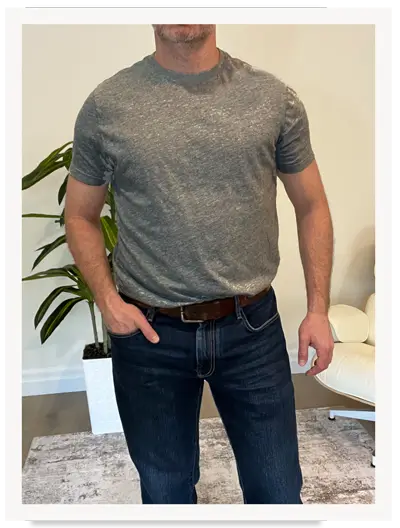
[Photo: Dave Bowden / Irreverent Gent]
By contrast, if you wear a gym shirt with denim or chinos, the synthetic texture of the shirt sends a totally different signal than the organic material of the pants, as if you’ve got two characters from two completely different movie genres trying to share the same screen:
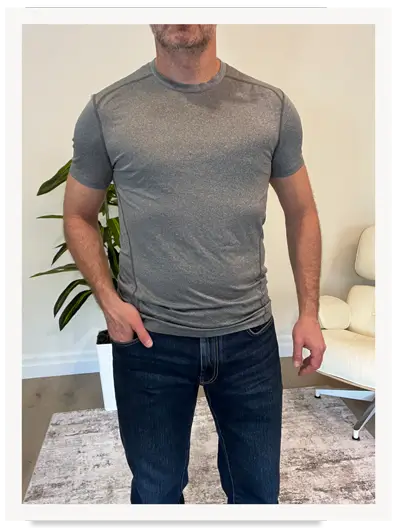
[Photo: Dave Bowden / Irreverent Gent]
But, if you pair that same gym shirt with a pair of polyester joggers and sneakers, the textures align, creating an “athletic guy who just finished a workout” vibe that’s different from a “jeans and cotton tee” vibe, but just as cohesive.
If you want your outfit to look intentional, make sure your fabrics are playing on the same team.
Pillar 4: Fit

Again, I’ve talked about the importance of fit at length elsewhere, and explained why you should use the Golden “1.6 to 1” Ratio as a rule of thumb.
But when it comes to cohesion, it’s not just about individual pieces fitting well, it’s about all of them fitting well together.
For instance, a chunky winter sweater can look great in certain cold-weather settings, but it establishes a pretty wide 1.6 baseline. Pairing it with skinny-fit jeans that hug your legs closely would throw off the Golden Ratio, creating a “1.6 to 0.7” look that feels disjointed.
In that case, a pair of regular fit jeans would be more appropriate; the extra heft would get you closer to the “1.6 to 1” ratio, and the looser fit would be more inline with the relaxed vibe established by the sweater.
Conclusion
The Cohesion Matrix
(the key to looking like you’ve got your shit together)
| Pillar | Core Question | What You’re Matching |
|---|---|---|
| 1. Vibe | What is the intention/setting? | Overall mood (e.g., Rugged, Sleek, Athletic) |
| 2. Color | Do the tones align with the vibe and context? | Palette temperature & formality level |
| 3. Fabric | Are the textures playing on the same team? | Natural vs. Synthetic, Rough vs. Smooth |
| 4. Fit | Are the proportions in balance? | Visual weight ratio across top and bottom |
Sharp style isn’t about wearing formal clothes, it’s about assembling outfits that are intentional, well put together and coherent.
Pairing the wrong pieces together throws off your look by pulling it in multiple directions, making it hard for people to know what impression they should have of you.
Cohesion is what turns a collection of decent pieces into a deliberate look. When the vibe is clear, the colors reinforce it, the fabrics make sense together, and the fits feel proportional, people read you as put together without consciously knowing why. You look like a guy who has his shit together, even if you’re dressed casually.
The good news is that cohesion doesn’t require a bigger budget or a closet overhaul. It requires a pause. Before you walk out the door, look yourself up and down in a full-length mirror and ask, “Do these pieces belong in the same outfit?” If the answer is yes across vibe, color, fabric and fit, you’re probably on solid ground.
Master cohesion, and everything else gets easier. Your outfits start working with you instead of against you. You waste less money. You make fewer style mistakes.
And, most importantly, you look sharper with less effort.